

'%3E%3Cg%20id='d'%3E%3Cg%20id='c'%3E%3Cg%20id='b'%3E%3Cpath%20id='a'%20stroke-width='1.3'%20d='m1%202%2034%2074%202%201v-2L9-2M8%2027c0%2011%207%2018%206%2028s5%2016%206%2020v7c1%201%204-3%203-8-1-6-5-7-4-20%201-12-5-15-4-26'/%3E%3Cuse%20href='%23a'%20transform='rotate(23)'/%3E%3C/g%3E%3Cuse%20href='%23b'%20transform='rotate(45)'/%3E%3C/g%3E%3Cuse%20href='%23c'%20transform='rotate(90)'/%3E%3C/g%3E%3Cuse%20href='%23d'%20transform='rotate(180)'/%3E%3Ccircle%20r='34'%20stroke-width='2'/%3E%3C/g%3E%3C/svg%3E)


Last reviewed on July 1st, 2026
If you walk through the heavy iron gates of Recoleta Cemetery looking only for historical dates, you are missing the point entirely. This is not a static repository of the dead. It is a labyrinth of stone where family secrets, broken hearts, political thrillers, and urban legends are frozen in marble and bronze.
Behind the grand facades of these miniature palaces lies the real history of Argentina—the one written in whispers, scandals, and tragedies. In this second part of our Recoleta guide, we escape the tourist brochures and dive deep into the most chilling, romantic, and bizarre stories hidden inside Buenos Aires’ city of the dead.
What Are the Most Famous Recoleta Cemetery Stories and Legends?
To truly understand the secrets guarded by these walls, you must stop before the resting places of those who inspired Buenos Aires' most enduring urban myths. These are the five essential stops:
1. Rufina Cambaceres: The Girl Who Died Twice

In 1902, Rufina Cambaceres was the crown jewel of Buenos Aires high society. Beautiful, wealthy, and the daughter of a famous writer, her life was an enviable dream. But on her 19th birthday, while preparing to attend a show at the Colón Theatre, her maid entered her room and found her completely rigid. She wasn't breathing. Her heart was silent.
Three doctors concluded she had suffered a sudden cardiac arrest. Devastated, her family rushed her burial, placing her coffin inside the dark, sealed family vault in Recoleta.
A few days later, a cemetery worker noticed a horrifying detail: the heavy marble door of the vault had shifted, and there was a crack in the coffin's lid. Fearing grave robbers, the family opened the tomb. What they found inside remains the most famous nightmare in Argentine history.
Rufina’s body had turned. The inside of the wooden lid was covered in frantic, bloody scratches. She hadn't died of a heart attack; she had suffered an episode of catalepsy —a rare condition that mimics death by dropping vital signs to near-imperceptible levels. Rufina had woken up trapped in the pitch-black silence of her own tomb, dying of asphyxiation hours later.
The guilt-ridden family completely redesigned her final resting place. Today, you will see a life-sized Art Nouveau statue of Rufina. She is not lying down; she is standing, her hand frozen in stone, gently gripping the handle of the door. She is eternally trying to escape.
2. Felicitas Guerrero: The Haunted Sanctuary of a Broken Heart

If you walk toward the back of the cemetery, you might notice an elegant, Gothic-style mausoleum that usually has small white ribbons tied to its iron gates. This is the resting place of Felicitas Guerrero, a woman whose life reads like a 19th-century gothic melodrama and stands as one of the most tragic legends of Recoleta Cemetery.
By age 24, Felicitas was the richest widow in Argentina. Her older husband had died, leaving her an immense fortune and vast lands. Beautiful and single, she became the obsession of every bachelor in Buenos Aires. But her heart belonged to a young landowner named Samuel Sáenz Valiente.
On a stormy night in January 1872, another fierce, rejected suitor, Enrique Ocampo, managed to corner Felicitas in her mansion. Mad with jealousy, Ocampo pulled out a pistol. "You will be mine or no one’s," he yelled before shooting her through the chest. Moments later, under mysterious circumstances, Ocampo was found dead in the same room—some say he shot himself; others whisper that Felicitas' cousins exacted immediate revenge.
Felicitas died the following morning. The tragedy shocked the nation. Today, local myth says that her ghost wanders the corridors of Recoleta on the anniversary of her death, her white dress stained with blood. Young women leave white ribbons on her gate to pray for true love, or to ask Felicitas to protect them from toxic, dangerous romances.
3. David Alleno: The Man Who Bought His Way In

Not everyone buried in Recoleta was a president or a millionaire. One of the most bizarre Recoleta cemetery stories belongs to David Alleno, a humble Italian immigrant who worked as a night watchman and gravedigger at the cemetery for over thirty years.
Living among the grand marble palaces of Argentina's elite, Alleno developed a singular, obsessive life goal: he wanted to be buried in Recoleta alongside the aristocrats he served. He saved every single peso from his modest salary for decades. He skipped meals, wore old clothes, and worked extra shifts.
Eventually, he saved enough to buy a small plot of land within the gates. He then traveled back to his native Italy to hire a sculptor to carve his own tombstone. The relief on his monument depicts Alleno himself, dressed in his worker’s uniform, holding his keys, a broom, and his watering can.
The urban legend says that once the intricate tomb was fully completed and the marble engraving read his name, Alleno walked home, put on his finest clothes, and took his own life. He simply couldn't wait any longer to occupy his masterpiece. To this day, cemetery workers claim they can still hear the faint, metallic jingle of Alleno’s keys echoing down the narrow stone alleys at night.
4. Liliana Crociati: Frozen in Her Wedding Dress

Among the neo-classical temples, one tomb stands out for its raw, heartbreaking modernism. Built from rough, dark stone and surrounded by glass panels, it features a bronze statue of a beautiful young woman wearing a flowing gown. Next to her sits a dog, his nose shiny and smooth from decades of visitors rubbing it for good luck.
This is the tomb of Liliana Crociati, who died in 1970 at just 26 years old. Liliana was an artist and a free spirit. While on her honeymoon in Innsbruck, Austria, a massive avalanche struck her hotel. The heavy wall of snow crushed her room, suffocating her instantly. Thousands of miles away, at exactly the same hour, her beloved dog Sabú died back in Buenos Aires.
Her grieving father, an Italian architect, refused to let her memory fade into a generic grave. He designed a tomb that replicated her bedroom. He sculpted Liliana in the exact dress she wore on her wedding night. When the sculpture was finished, he added the bronze figure of Sabú at her side. It is a monument of pure, unadulterated grief—a father's attempt to keep his daughter and her loyal companion together for eternity.
5. Eva Perón: The Corpse That Refused to Rest

As covered in our logstics guide, Evita’s tomb is the most visited spot in Recoleta. But the real story isn't the Duarte family vault you see today—it’s the terrifying, 24-year Odyssey her corpse endured before reaching it.
When Eva Perón died of cancer in 1952, her husband, President Juan Domingo Perón, hired a master embalmer who turned her body into a flawless, lifelike wax-like statue. When a violent military coup overthrew Perón in 1955, the new dictators faced a terrifying problem: Evita's body was a powerful political symbol. If her followers found it, it could spark a revolution.
So, the military stole her corpse. What followed was a macabre game of hide-and-seek. For months, the body was moved through Buenos Aires in the back of unmarked trucks, hidden in city safehouses, and even tucked behind a cinema screen. Dictators reportedly kept her in their offices, driven mad by the fear of her legacy.
Eventually, the military secretly shipped her to Italy under a fake name ("Maria Maggi"), burying her in a modest cemetery in Milan. Decades later, her body was exhumed, shipped to Spain to a exiled Perón, and finally returned to Argentina in the 1970s. Today, she rests 20 feet underground, protected by three heavy steel plates inside a vault designed to withstand nuclear blasts. The state wanted to make absolutely sure she would never be stolen again.
Secret Code: Decoding the Symbols on Recoleta Cemetery's Famous Tombs
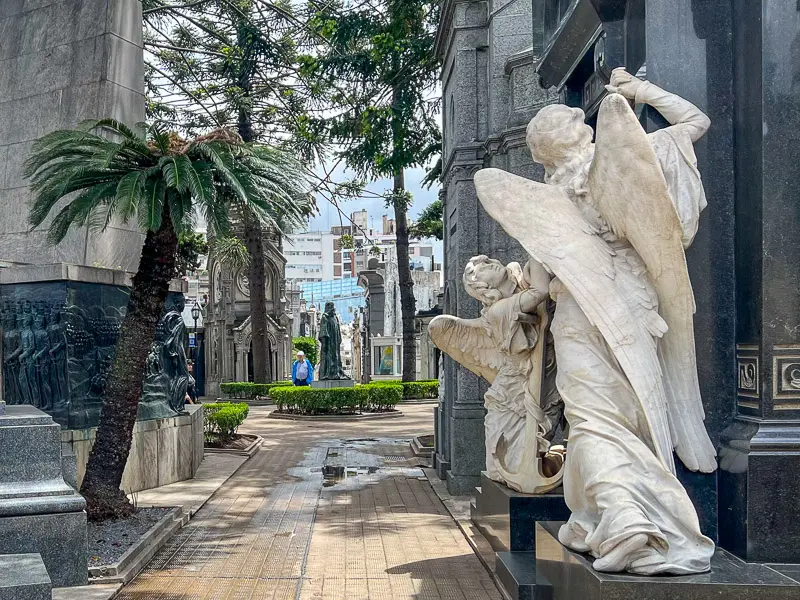
When you walk through Recoleta, the statues aren't just decorative; they are speaking to you through a secret Victorian code of mourning. If you know how to look, you can read the fate of the person inside without knowing their name:
Conclusion: The Stories that Outlive the Marble
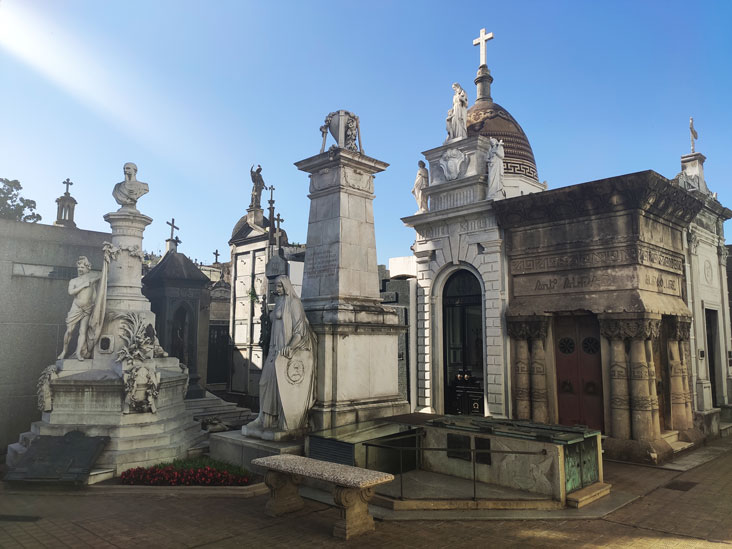
Ultimately, Recoleta Cemetery is not about death; it is about the desperate human desire to be remembered. Wealthy families spent millions trying to conquer time with marble, granite, and bronze. Yet, visitors don't flock to these gates to marvel at the cost of the stone. They come for the stories.
When you stand before Rufina’s door, or touch the nose of Liliana’s dog, you realize that the elite families of Buenos Aires did get exactly what they paid for: immortality. Not through their wealth, but through the haunting, beautiful legends that continue to echo down these silent stone streets.